Retire or Rewear? When Activewear Has Actually Earned Retirement
Quick Answer: Retire activewear when you see two or more of these: knees that stay baggy after washing, sheerness when you bend, a waistband that rolls no matter what, permanent odour that survives a vinegar soak, or pilling you can feel from the inside. Two failures are still rescuable — mild smell (vinegar soak) and light pilling (a $8 fabric shaver). Everything else has honourably earned retirement.
Budget shopping has a partner skill nobody teaches: knowing when a piece is actually done.
Retire too early and you’re throwing money away. Retire too late and you’re squatting in front of a mirrored wall discovering something about your leggings that everyone behind you discovered twenty minutes ago.
Here are the five honest signs — and the two failures you can still fix.

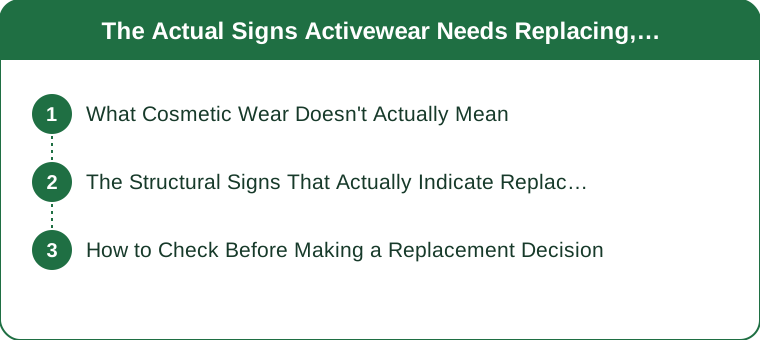
What Are the Signs Activewear Is Worn Out?
Five diagnostics. Any two together and it’s done.
1. Knees that stay baggy after washing. Elastane has a lifespan, and when it goes, the fabric stops recovering its shape. A fresh-from-the-dryer legging that already has knee bags is telling you the elastane is deceased. There’s no fix.
2. Sheerness at stretch. The bend-over test, done at home, in daylight, in front of a mirror — not discovered in a squat rack. Fabric thins as fibres break down, and sheerness is irreversible.
3. A waistband that rolls no matter what. If it folds down within ten minutes of every session regardless of rise or size, the internal structure is gone. Constant adjusting is a tax you’re paying on a garment that stopped working.
4. Permanent odour that survives a proper wash. Bacteria colonise synthetic fibres, and past a certain point they’ve won. If it smells fine in the drawer and smells terrible eight minutes into a warm-up, that’s embedded odour.
5. Pilling you can feel from the inside. Surface pilling is cosmetic. Pilling you feel against your skin means the fabric structure has broken down, and it will only get worse.
Bonus one people ignore: a sports bra that’s lost its band tension. If you’ve moved to the tightest hook and it still rides up, it’s done, regardless of how the cups look.
Which Failures Can You Still Rescue?
Two, and both are worth one attempt before you make the call.
Mild odour → the vinegar soak. Soak the garment in a solution of roughly one part white vinegar to four parts cold water for 30–60 minutes, then wash cold on its own with a small amount of detergent and no fabric softener. Air dry. This works on odour that’s beginning to embed, not odour that’s been there for a year.
Prevention beats rescue here: don’t leave sweaty kit balled in a bag, skip fabric softener entirely (it coats fibres and traps bacteria), and wash cold rather than hot.
Light pilling → a fabric shaver. About $8, takes five minutes, and is oddly satisfying in a way that’s difficult to explain until you’ve done it. It genuinely restores the look of a garment that’s otherwise structurally fine.
Try the rescue once before the verdict. Some pieces just need a spa day.

What Do You Do With Retired Activewear?
Not landfill-by-default, which is where most of it goes.
- Painting, gardening, decorating, moving house. Failed leggings are excellent at all of these, and it postpones buying dedicated clothes you’d wear four times.
- Textile recycling. Many retailers and municipalities run take-back schemes that accept worn synthetics. Not perfect, considerably better than the bin.
- Loungewear, if the failure is cosmetic pilling rather than structural.
- Cut into cleaning rags — synthetic knit is actually good for this.
Do not donate visibly worn-out activewear. Charities pay to dispose of unsellable donations. Sheer leggings aren’t a gift.
And a public safety note: the seat-sheerness pair retires from public squatting immediately, whatever else you decide about it.
How Do You Do the Replacement Math?
Track lifespan loosely and let the data tell you where to spend.
Cost per year is the number that matters. A $30 legging that lasts one year costs $30/year. A $70 legging that lasts three years costs $23/year — and you enjoyed wearing it more the whole time. But a $110 legging that also lasts three years costs $37/year, so “expensive” isn’t automatically the answer either.
Keep it simple: note roughly when you bought a piece (a note in your phone is plenty), and when you retire it, do the division. After two or three cycles you’ll know which brands and price points actually last for how you train.
Audit twice a year. Pull everything out, run the five signs, apply the two rescues, retire what’s done. Fifteen minutes, twice a year, keeps the drawer honest.
What extends lifespan — and this is where the real savings are: wash cold, gentle cycle, inside out, no fabric softener, air dry always. The tumble dryer is what kills elastane faster than anything else you do. And rotate: owning four pairs and wearing each weekly beats owning two and wearing them into the ground.
How often should you replace leggings?
Roughly 1–3 years with regular use, depending on quality, wash frequency and how you dry them. The calendar matters less than the five signs — check for baggy knees, sheerness, a rolling waistband, embedded odour and internal pilling, and retire on any two.
How do you get the smell out of workout clothes?
Soak in one part white vinegar to four parts cold water for 30–60 minutes, then wash cold with a little detergent and no fabric softener, and air dry. If the smell survives that, the odour is embedded and the garment is done.
Is it worth buying expensive activewear?
Sometimes. Calculate cost per year rather than sticker price — a $70 pair lasting three years beats a $30 pair replaced annually. Past a certain price point, though, you’re paying for branding rather than lifespan, which is why tracking your own results matters more than reviews.
TL;DR:
- Five retirement signs: baggy knees, sheerness, rolling waistband, permanent odour, internal pilling. Any two = done.
- Two rescues: vinegar soak for mild smell, an $8 fabric shaver for light pilling. Try once.
- Sheer-seat leggings retire from public squatting immediately.
- Repurpose or textile-recycle. Don’t donate worn-out kit; charities pay to dispose of it.
- Do the cost-per-year math after each retirement to learn where your money actually goes.
- Air dry always — the tumble dryer kills elastane faster than anything else.
See It in Motion
Seen here: High Waist 8” Yoga Shorts — shop similar styles on bubblelime.com
Keep Reading
This article is for general informational and styling purposes only. Fit, sizing, and product availability may vary.