How to Audit Your Activewear Drawer Before You Buy Anything Else
Quick Answer: Empty everything onto the bed, sort into four piles - wear weekly, wear sometimes, never wear, worn out - and count what you actually own by category rather than by number. Almost everyone finds the same pattern: too many mid-support bra tops and mid-weight leggings, and genuine gaps at the edges. Forty minutes, and it converts a vague sense of needing new things into a short specific list, which is what prevents the expensive random purchase.
You stand in front of a full drawer and think - I have nothing to wear to the gym.
Both things are usually true at once, and the audit is how you find out which pieces are actually missing.

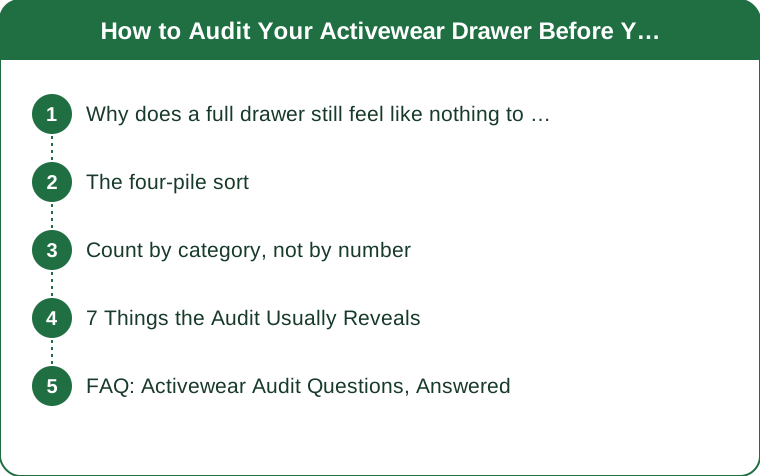
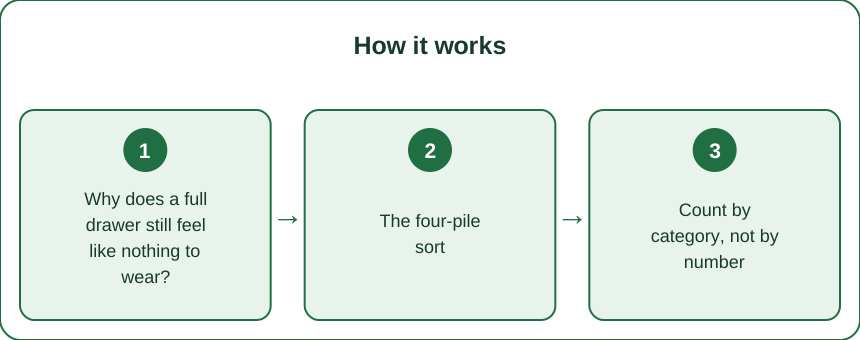
Why does a full drawer still feel like nothing to wear?
Because activewear accumulates by opportunity rather than by plan.
Most drawers are built from sale purchases, gifts, event t-shirts, things bought for a phase of training that ended, and replacements for items that were never actually thrown out. Nothing in that process produces a balanced set.
The result is a specific and very common pattern: several near-identical mid-weight black leggings, a large number of medium-support bra tops, a stack of cotton t-shirts that are uncomfortable to train in, and genuine gaps in whatever you now actually do.
There is also the dead-stock problem. Items that have quietly stopped working - a legging that has gone sheer, a bra top whose band no longer holds - stay in the drawer because they look fine folded. They take up space in the count without being available in practice.
So the feeling is accurate. You own a lot, and you own fewer usable things than the volume suggests.
The four-pile sort
Take everything out. All of it, onto a bed, including what is in the wash and the gym bag. Volume is part of the information.
Pile 1 - wear weekly. The things you reach for by default. For most people this is a surprisingly small number, often five to eight items.
Pile 2 - wear sometimes. Genuine backups. They work, you use them on laundry day or for specific activities.
Pile 3 - never wear. Be honest. If it has not been worn in a year of training, there is a reason, and the reason is usually fit, chafe, or opacity. Try to name the reason - that information is what stops you buying the same thing again.
Pile 4 - worn out. Sheer leggings, bra tops that ride up, pilled fabric, broken elastic, holes.
Pile 4 leaves the drawer today. Pile 3 needs a decision: sell, donate, or repurpose as loungewear. Pile 1 tells you what to buy more of, and pile 2 is your buffer.
The useful realisation is usually the size of pile 1 relative to the total. Owning thirty items and wearing six is common.

Count by category, not by number
This is the step that produces the shopping list.
Go through pile 1 and pile 2 and count by what the item does:
- Bottoms, split into full-length, shorts, and anything with pockets you use
- Bra tops, split into high, medium, and light support
- Tops, split into technical and non-technical
- Layers - a long-sleeve, a jacket, something for cold or wet training
- Socks, which almost everyone is short of and nobody counts
Then compare against what you actually do in a week. Someone who runs three times and lifts twice needs at least two or three high-support bra tops, weather layers, and running socks. Someone who does yoga and walks needs almost none of that and more light-support tops.
The gaps are almost always at the edges: high support, weather protection, and enough socks. The surplus is almost always in the middle.
Write the gaps down as a list of at most four items. That list is the entire point of the exercise.
7 Things the Audit Usually Reveals
1. You own three of the same legging. Different brands, same weight, same colour, bought at different times. One is enough in the rotation, and the other two are backups you never reach.
2. Something has quietly gone sheer. Fabric thins with wear and it is invisible when folded. Squat in front of a mirror - it takes ten seconds and it is the single most useful test in the whole audit.
3. You are short on high support. The category that matters most for impact training and the one most likely to be missing, because medium-support tops are what get bought on sale.
4. Half your tops are cotton. Cotton holds sweat, stays wet, and chafes. Event t-shirts accumulate and quietly become the default, and they are the worst option in the drawer.
5. Nothing works for rain or cold. Autumn is the moment this bites. A wind-resistant layer is what determines whether outdoor training continues in October.
6. You are wearing worn-out socks. Flattened, thin, or with lost elastic - the cheapest fix available and the one with a disproportionate effect on comfort.
7. Your favourite item is discontinued. Which is the argument for buying two of anything that genuinely works, the moment you discover it works.
FAQ: Activewear Audit Questions, Answered
How often should I do this?
Twice a year is plenty - once as the seasons change in late summer, and once in spring. Late August is the better of the two because end-of-season sales are running and you can fill the gaps immediately.
Is it worth selling used activewear?
Well-known brands in good condition do hold resale value, and it is worth the effort for a handful of higher-value items. Anything pilled, faded, or stretched is a donation rather than a sale.
How do I know if leggings have gone sheer?
Squat facing a mirror in good light, ideally daylight. If the fabric lightens noticeably across the seat, it is done for training and may still be fine for home wear.
What if my gaps add up to more than I want to spend?
Buy in priority order: the high-support bra top first, then the weather layer, then socks, then bottoms. The first two affect whether training happens at all; the rest is comfort.
TL;DR:
- A full drawer with nothing to wear is normal - activewear accumulates by opportunity, not by plan.
- Sort into four piles: weekly, sometimes, never, worn out. Pile 1 is usually only five to eight items.
- Count by category, not by number - support level, weather layers, socks - against what you actually do weekly.
- The surplus is almost always mid-support tops and mid-weight leggings; the gaps are at the edges.
- Do the squat mirror test. Sheer fabric is invisible when folded.
- Leave with a list of four items maximum. That list is the whole point.
Forty minutes now, during end-of-season sales, and the next purchase is a specific gap rather than a hopeful guess.
See It in Motion
Seen here: Racerback Tank Top - White — shop similar styles on bubblelime.com
Keep Reading
This article is for general informational and styling purposes only. Fit, sizing, and product availability may vary.