Repair or Replace: What Is Actually Worth Fixing in Your Activewear Drawer
Quick Answer: Repair anything where the fabric itself is intact — seam splits, waistband drawcords, hems, small snags, hook and elastic hardware. Replace anything where the fabric or the elastane has failed — pilling through, transparency when stretched, permanent bagging, and lost recovery. The distinction is not how bad it looks; it is whether the material still has its properties.
The seam has gone on your best leggings and you are about to bin them. There is a decent chance that is a twenty-minute fix and another two years of wear.
There is also a decent chance the ones you are keeping are the ones actually finished.

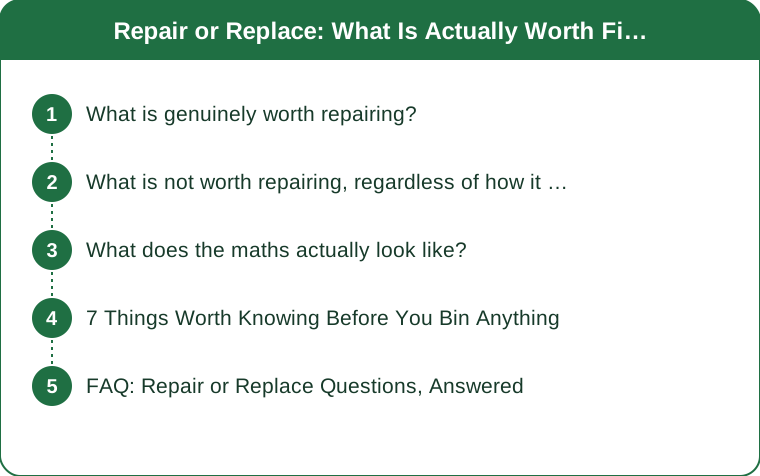
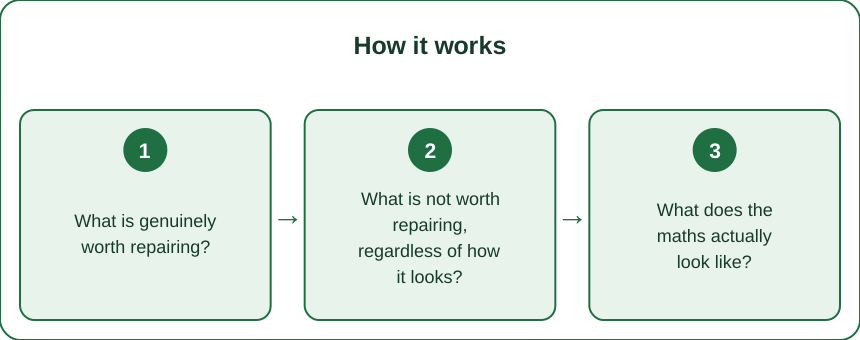
What is genuinely worth repairing?
Anything where the fabric is fine and something attached to it has failed.
Seam splits. By far the most common repair and the easiest. A split along a side seam or an inseam, where the fabric on both sides is undamaged, is a straightforward fix. Use a stretch stitch or a narrow zigzag — a straight stitch will snap the first time the seam is loaded, which is why home repairs on stretch fabric so often fail. Cost: essentially nothing. Time: fifteen to twenty minutes.
Broken or pulled-out drawcords. A safety pin and five minutes. The waistband channel is intact; only the cord moved.
Failed waistband elastic in a garment with a separate elastic band. Replaceable in most joggers and shorts, less so in bonded technical waistbands. If you can feel a distinct band inside a channel, it can be swapped.
Hems that have come undone. Twenty minutes, and the fabric is untouched.
Small snags and pulls. Do not cut them. Pull them through to the wrong side with a needle or a snag-repair tool. A snag is displaced yarn, not missing yarn, and cutting it creates a hole where there was not one.
Bra hardware. Hooks, sliders, and rings are replaceable and cost very little. A sports bra with perfect elastic and a broken slider is not a dead garment.
Small holes in a low-stress area. Patchable from the inside with a stretch fusible patch, which is genuinely durable if the area does not stretch much.
What is not worth repairing, regardless of how it looks?
Anything where the material has changed properties. These are not fixable at any price, and people spend money trying.
Lost elastane recovery. This is the real end of a garment’s life and it is not visible until you test it. Stretch the waistband and let go. If it returns slowly or does not return fully, the elastane has degraded. Nothing restores it — not washing, not drying, not any product. The garment will bag out within an hour of wear from now on.
Transparency when stretched. Hold the fabric over your hand and stretch. If light comes through where it did not before, the fabric has thinned through wear and abrasion. It will only get thinner.
Pilling that has gone through. Surface pilling can be shaved and the garment is fine. Pilling that has thinned the fabric underneath has removed material, and shaving it removes more.
Permanent bagging at the knees or seat. If it does not come back after a wash and a dry, the fibres in that area have been permanently deformed.
Odour that survives washing. This is bacteria embedded in synthetic fibre, and while a vinegar or specialist sports wash sometimes helps in early cases, an established case in an old garment usually does not resolve. It also tends to indicate the fabric has broken down enough to hold residue.
Delaminated bonded seams. The bonding on flatlock or bonded seams cannot be re-bonded at home, and stitching over it changes the garment’s comfort significantly.

What does the maths actually look like?
Simple, and it favours repair more often than people assume.
The comparison is not repair cost versus replacement cost. It is repair cost per remaining wear versus replacement cost per total wear.
Take a pair of leggings bought for 60 with a split inseam after eighteen months and maybe 120 wears. That is 50p a wear so far. A twenty-minute repair costing nothing in materials extends them by, say, another eighteen months. The cost per wear drops to around 25p.
A replacement at 60 starts again from zero, and there is a real chance the new pair is not as good — fit, fabric, and cut all change between seasons, and the specific pair you liked frequently no longer exists.
Where paid repair makes sense: a professional alteration or repair on a genuinely expensive garment. A 15 to 25 repair on a 120 jacket with several years left is obviously worthwhile. The same repair on a 25 pair of leggings is not.
The decision rule:
- Fabric intact + you like the fit → repair, almost always, if you can do it yourself.
- Fabric intact + expensive garment → pay for the repair.
- Fabric failed → replace, and do not spend anything first.
One thing worth doing before either: check the warranty. Several activewear brands have genuinely good repair or replacement policies, some running years, and a seam failure is frequently covered. It costs an email to find out.
7 Things Worth Knowing Before You Bin Anything
1. Test recovery before you decide. Stretch the waistband and let go. This single test tells you more than looking at the garment does, and it is the difference between repairing something with two years left and repairing something that is finished.
2. Never use a straight stitch on stretch fabric. It will fail immediately under load. A narrow zigzag or a stretch stitch, and a ballpoint or stretch needle, which does not cut the fibres as it passes through.
3. Snags are pulled through, never cut. Cutting turns a cosmetic problem into a hole.
4. A fabric shaver is the highest-return tool you can own. It costs very little and it makes pilled but structurally sound garments wearable again. Most items binned for looking worn are shaveable.
5. The failure is often the thread, not the fabric. Polyester thread degrades with heat and UV faster than the fabric around it. This is why seams go on garments that are otherwise perfect — and it is why re-stitching gives you the full remaining life of the fabric.
6. Retire rather than bin. A pair with failed recovery is finished as workout wear and perfectly fine as a base layer under trousers, for sleeping, or for painting. This is not sentimentality; it delays buying something else for that purpose.
7. Textile recycling exists and most people do not use it. Several retailers run take-back schemes, and synthetic activewear is very difficult to dispose of well otherwise. If it is genuinely finished, this is where it should go rather than in general waste.
FAQ: Repair or Replace Questions, Answered
How do I repair a seam if I cannot sew?
A basic hand-sewn backstitch with a small amount of give, or a stretch fusible bonding tape applied with an iron on a low setting. Both are learnable in one video. For a seam under real load — an inseam or a crotch seam — hand sewing is more durable than fusing, and it is worth doing properly.
Is it worth taking activewear to a tailor?
For expensive items, yes. Not all tailors work with technical stretch fabrics, so ask first. Expect a modest charge for a seam repair, which is straightforwardly worth it on anything above roughly 60.
How long should activewear actually last?
With reasonable care, quality leggings commonly last two to three years of regular use before recovery starts to go. Sports bras have shorter lives — often one to two years, or roughly 30 to 40 wears for high-support styles — because the elastic works harder. Bras are the item most people keep long past their useful life.
What care makes the biggest difference to lifespan?
Cold wash, no fabric softener, and air drying. Heat is what destroys elastane, and the tumble dryer is responsible for more early failures than wear is. This alone can roughly double how long a garment holds its shape.
TL;DR:
- Repair anything where the fabric is intact: seam splits, drawcords, hems, snags, bra hardware.
- Replace anything where the material has changed: lost recovery, transparency when stretched, pilling through, permanent bagging, embedded odour.
- Test recovery first — stretch the waistband and let go. It decides everything.
- Use a zigzag or stretch stitch and a ballpoint needle. A straight stitch will fail immediately.
- Pull snags through, never cut. Buy a fabric shaver; it rescues most items binned for looking worn.
- Check the warranty before spending anything. Seam failures are often covered.
The ones you are about to bin may have two years left. The ones you are keeping may already be finished.
See It in Motion
Seen here: Super High Waist Embossed Yoga Leggings with Inner Pocket — shop it on bubblelime.com
Keep Reading
This article is for general informational and styling purposes only. Fit, sizing, and product availability may vary.