What Is Worth Buying in the End-of-Season Activewear Clearance
Quick Answer: Late August and September clearance is heavily weighted toward summer-specific pieces - shorts, tanks, and bright colours - which are exactly what you will not wear for eight months. The genuinely good buys are core leggings in last season’s colourway, sports bras, and anything in a discontinued neutral. Skip outerwear and cold-weather gear now; it is full price and will be marked down in January.
A sale is only a saving on something you were going to buy anyway. The clearance rack is very good at making that distinction disappear.

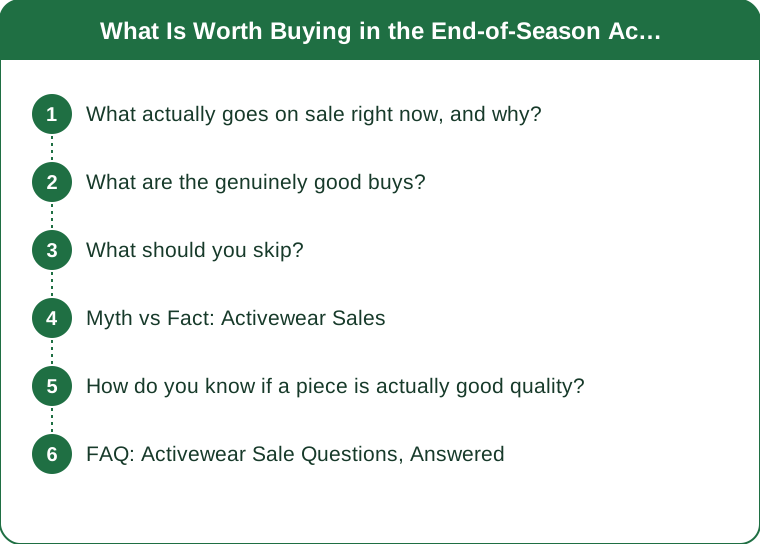
What actually goes on sale right now, and why?
Retailers are clearing summer inventory to make room for autumn and holiday stock. That timing dictates everything about what is discounted.
Heavily discounted in late August and September:
- Shorts, in every length
- Tanks and sleeveless tops
- Bright and seasonal colourways
- Swim and water-specific gear
- Lightweight and mesh-heavy pieces
Barely discounted:
- Leggings in core colours, which sell year-round
- Outerwear and cold-weather layers, which are just arriving
- New-season launches
The trap this creates. The deepest discounts are on the items with the longest wait before you can use them. A 60% discount on running shorts in September means storing them for eight months, during which your size may change, your preferences may change, and the enthusiasm that drove the purchase will certainly have faded.
The exception that makes it worthwhile: if you know from experience you wear a specific short every summer and yours are worn out, buying two now at 60% off is a genuinely good decision. The distinction is between replacing something proven and speculating on something new.
One structural note on the calendar: activewear has two major clearance windows - late summer for summer stock, and January for winter stock and holiday overstock. Anything cold-weather bought now is at the worst possible point in the cycle.
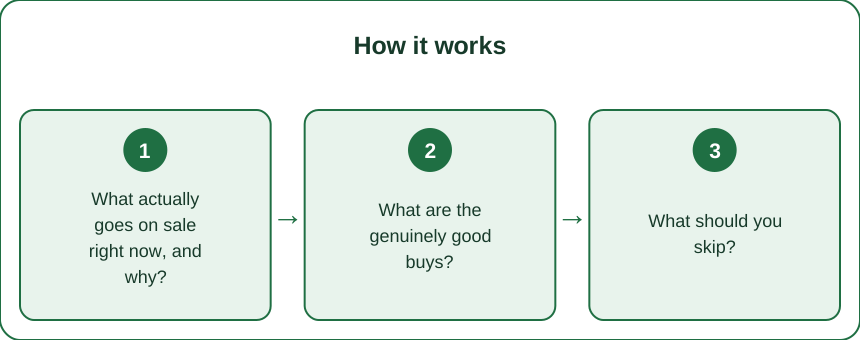
What are the genuinely good buys?
Four categories, in order of value.
1. Core leggings in a discontinued colourway. The best buy on the rack. Brands cycle colours constantly, and last season’s black or navy in the current cut is functionally identical to the new one at a substantial discount. Check that the cut is the same as the current version, not an older pattern - the colour changing is fine, the fit changing is not.
2. Sports bras. Frequently discounted, always needed, and they wear out on a predictable schedule. If you have found one that fits, buying two on sale is one of the few genuinely uncomplicated wins in this whole category. Elastic degrades over time even unworn, so buying five is not sensible - two is.
3. Long-sleeve base layers. These often sit in the summer clearance because they were part of a spring range, and they are exactly what you need for the next six months. This is the most consistently overlooked good buy.
4. Socks. Unglamorous, always discounted, and technical running socks at half price are a real quality-of-life upgrade if you are still running in cotton.
What about shoes? Running shoes go on clearance when a model updates, and the previous version is usually near-identical. This is a legitimate saving on an expensive item, with one condition: only if it is the model you already run in and you know your size in it. Buying a discounted shoe you have not run in because it is a good price is how people end up with an injury and a pair of shoes they do not wear.
What should you skip?
Three categories, and the reasoning is the same for all of them.
Anything cold-weather, right now. Jackets, thermal layers, fleece-lined leggings, and winter running gear are all newly arrived at full price. They will be discounted in January. If you need something for October, buy the single item you need; do not build a winter wardrobe in September.
Anything in a size you are not currently. The most expensive category of mistake, and it happens most on sale racks. A discounted item in the wrong size is not a saving.
Anything for an activity you have not started. Sale racks are extremely good at converting a vague intention into a purchase. If you have not been to a yoga class in a year, the discounted yoga set is not the thing that will change that, and it is a well-known pattern that the gear purchase substitutes for the activity rather than enabling it.
And the honest one: anything you are buying because the discount is large. The relevant question is what you would pay for it if it were full price. If the answer is nothing, the discount is irrelevant. Percentage-off framing is the single most effective retail mechanism there is, and being aware of that is most of the defence against it.
A useful practical filter: photograph the item, leave the shop, and if you still want it tomorrow, go back. Online, put it in the basket and close the tab. The proportion of sale purchases that survive twenty-four hours is much lower than people expect, and that is the point of the exercise.
Myth vs Fact: Activewear Sales
Myth: Expensive activewear lasts proportionally longer. Fact: There is a real quality floor below which fabric pills, seams fail, and leggings go semi-transparent quickly. Above roughly the mid-range, the additional cost buys design, brand, and marginal fabric improvements rather than proportional durability. The value curve flattens well below the premium price point.
Myth: Buy the same item in multiple colours when it is on sale. Fact: Reasonable for something you have owned and worn out. Otherwise you have multiplied a single untested decision, and if the fit is not right you now own three.
Myth: End-of-season is the cheapest it will ever be. Fact: Deeper markdowns often come a few weeks later as stock needs to clear entirely, with the trade-off that sizes disappear. If your size is common, waiting often pays; if it is at either end of the range, buy when you see it.
Myth: Outlet versions are the same product at a lower price. Fact: Sometimes they are genuine past-season stock. Frequently they are made specifically for outlet channels at a lower specification. Check the fabric composition and the weight against the main-line version rather than assuming.
Myth: You need separate gear for each activity. Fact: A good pair of leggings and a supportive bra covers the large majority of activities most people actually do. Activity-specific gear matters for a small number of things - proper running shoes, real swim fabric, a genuinely supportive bra for high impact - and is mostly a marketing construct beyond that.
How do you know if a piece is actually good quality?
Five checks that take under a minute and do not require any expertise.
The stretch test for opacity. Stretch the fabric over your hand or your knee in daylight. If you can see skin tone through it, it will be semi-transparent when you bend over. This is the single most common failure and the easiest to check - and it is the reason to do it in the shop rather than in a dark changing room.
The recovery test. Stretch the fabric and let go. It should snap back completely and immediately. Slow or incomplete recovery means low-quality elastane, and it will bag out at the knees within a month.
The seam check. Look at the inside seams. Flatlock seams - flat, wide, stitched down - are more comfortable and more durable than a simple overlocked edge. Check the crotch seam in particular, because it takes the most stress and it is where cheap leggings fail first.
The weight test. Hold it. Quality activewear has a certain density to it. Very light fabric in a legging usually means opacity problems and a short life. There are legitimate lightweight pieces, and they are the exception rather than the bargain-rail norm.
The waistband. Wide, and thick enough to hold shape when you stretch it. A thin waistband rolls down, and no amount of correct sizing prevents it.
One more that costs nothing: check the fabric composition on the label. For leggings, look for a reasonable elastane percentage - typically somewhere in the mid to high single digits or low teens depending on the fabric. Very low elastane means poor recovery; very high can mean a compression fabric that is uncomfortable for everyday wear.
The overall principle for a clearance rack: the discount tells you nothing about the quality. Run the same five checks you would run at full price, and buy on the checks rather than on the sticker.
FAQ: Activewear Sale Questions, Answered
When is the best time to buy activewear?
Late August through September for summer stock, and January for winter stock and overstock. Core items like black leggings rarely go deeply discounted at any point.
Should I buy summer shorts now for next year?
Only if you are replacing something you already wear every summer and know the fit. Speculating on new pieces you will store for eight months rarely works out.
Is the outlet version the same as the main line?
Not always. Some outlet stock is made specifically for that channel at a lower specification. Compare the fabric composition and weight to the main-line item.
How many pairs of leggings do I actually need?
Three covers most people - one in the wash, one in use, one clean. More than that and the extras tend to be worn rarely, which means the elastic degrades with age rather than with use.
How do I check for see-through in a shop?
Stretch the fabric over your hand under the shop lights and look for skin tone. Then squat in the changing room mirror. Both take five seconds and prevent the most common regret.
TL;DR:
- The deepest discounts are on summer pieces you will not wear for eight months
- The good buys are core leggings in last season’s colour, sports bras, base layers, and socks
- Skip cold-weather gear now - it is at full price and gets marked down in January
- Run the opacity, recovery, seam, weight, and waistband checks regardless of the discount
- A sale is only a saving on something you were already going to buy
Photograph it, leave the shop, and see if you still want it tomorrow. Most sale purchases do not survive that test, which tells you what they were.
See It in Motion
Seen here: High Waist 8” Yoga Shorts — shop similar styles on bubblelime.com
Keep Reading
This article is for general informational and styling purposes only. Fit, sizing, and product availability may vary.