How Many Leggings Do You Actually Need? The Number That Saves You Money
Quick Answer: Most women need 5-7 pairs of leggings total - 2 for high-sweat workouts, 2-3 for everyday low-impact wear, and 1-2 for lounging or travel. Anything beyond that is usually duplicate coverage, not extra function.
You open the drawer and there are 14 pairs of leggings staring back, half of them barely worn. Buying “just one more pair” feels harmless every single time. Here’s the actual number that stops the cycle and saves real money.
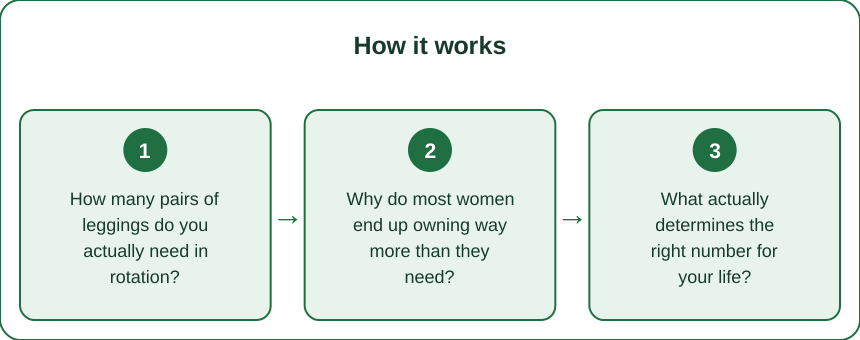
How many pairs of leggings do you actually need in rotation?
5-7 pairs is the realistic sweet spot for someone who works out 3-5 times a week and also wears leggings casually. That breaks down to roughly 2 heavy-sweat pairs for high-intensity training, 2-3 everyday pairs for walking, errands, or low-impact classes, and 1-2 comfort pairs for travel or lounging.
If you work out fewer than 3 times a week, 4 pairs total is usually plenty - 2 for workouts and 2 for casual wear, with a wash day in between so you’re never scrambling.
The math is simple once you write it down: a 2-pair rotation covers 2 workout days before laundry, so if you train 4-5 days a week without doing mid-week laundry, you need at least 4 workout-grade pairs, not 2. Counting your actual weekly workout days first is the step most people skip before buying.
Why do most women end up owning way more than they need?
Sales pressure is the biggest driver. A $70 pair marked down to $28 feels like a smart buy in the moment, even when your drawer is already full - the discount, not the actual need, is what triggers the purchase.
Color and print variety is the second trap. Buying the same style in black, navy, and olive feels like “building a wardrobe,” but if you’re only ever reaching for the black pair, the other two are just taking up drawer space and capital that could’ve gone toward one genuinely higher-quality piece.
A third overlooked reason: leggings rarely wear out visibly, so there’s no natural cue to stop buying the way a hole in a sock or a stretched-out t-shirt collar would prompt a replacement. Pilling happens gradually enough that most people don’t notice it until they’re doing a side-by-side comparison with a newer pair.
What actually determines the right number for your life?
Workout frequency is the single biggest variable. Someone training 5 days a week genuinely needs more pairs in rotation than someone training twice a week, since laundry frequency has to match wear frequency or you run out mid-week.
Laundry schedule matters almost as much. If you do laundry twice a week, you can get away with fewer pairs than someone who only washes activewear every 10 days. Be honest about your actual laundry habits, not your aspirational ones, when doing this math.
Climate and season shift the number too - someone who layers leggings under other clothes in cold months may need 1-2 extra pairs for that season specifically, while someone in a warm climate year-round can often stay at the lower end of the 5-7 range without missing anything.

5 Mistakes Everyone Makes When Building a Leggings Collection
1. Buying based on a sale instead of a gap. Before adding a new pair, check what you actually reach for weekly - if you already own 3 black pairs, a 4th one on sale isn’t solving a real problem.
2. Keeping pairs that have lost their compression. Once leggings stretch out and stop bouncing back, they’re taking up drawer space without doing their job - donate or repurpose them instead of counting them in your active rotation.
3. Assuming more pairs means less laundry work. In reality, owning 12 pairs just means bigger laundry piles less often, not less total washing - the math evens out either way.
4. Ignoring cost-per-wear. A $60 pair worn 100 times costs $0.60 per wear; a $20 pair worn twice before it pills costs $10 per wear - the cheaper price tag isn’t always the cheaper choice.
5. Buying the same fabric weight for every use case. A single “do everything” pair often underperforms at both ends - too thin for cold-weather layering, too thick for a sweaty studio class. Splitting your rotation by use case usually serves you better than one universal pair repeated 6 times.
How do you actually downsize an overgrown leggings drawer?
Start by laying every pair out and sorting into three piles: worn weekly, worn occasionally, and rarely or never worn. The rarely-worn pile is almost always bigger than expected - that’s your starting point for donation or resale.
For the “occasionally worn” pile, ask why they’re not in regular rotation - too tight, wrong length, itchy waistband. If the answer is a fixable comfort issue, that pair is telling you something about future purchases, not just this one.
Once you’re down to your core 5-7, resist restocking the gap immediately. Live with the smaller number for 2-3 weeks first; most people find they don’t miss the extras nearly as much as they expected, and the ones they do miss reveal what to actually replace.
FAQ: How Many Leggings You Need, Answered
Is it wasteful to own more than 7 pairs?
Not inherently - if you genuinely wear all of them in rotation, more pairs just means less frequent laundry. It becomes wasteful specifically when pairs sit unworn for months.
Should workout leggings and everyday leggings be different?
Ideally yes. Workout pairs benefit from moisture-wicking, higher compression fabric, while everyday pairs can prioritize softness and comfort over sweat performance, which usually costs less per pair.
How do I know when it’s time to replace a pair instead of adding a new one?
If the waistband has lost its snap-back, the fabric has visible pilling in the thigh-rub zone, or you can see through it when stretched, that’s a replacement, not a wardrobe expansion - swap it out rather than adding to the pile.
TL;DR:
- 5-7 pairs covers most active lifestyles: 2 heavy-sweat, 2-3 everyday, 1-2 lounge
- Match your pair count to actual workout frequency and laundry schedule, not sale prices
- Cost-per-wear matters more than the sticker price
- Downsizing starts with sorting into worn-weekly, occasional, and rarely-worn piles
Count your real weekly workout days before your next purchase - it’s the fastest way to stop buying leggings you’ll barely wear.
See It in Motion
Seen here: Super High Waist Embossed Yoga Leggings with Inner Pocket — shop it on bubblelime.com
Keep Reading
This article is for general informational and styling purposes only. Fit, sizing, and product availability may vary.