The Cost-Per-Wear Maths That Changes How You Buy Activewear
Quick Answer: Divide price by realistic total wears, and factor in that elastane-heavy garments have a lifespan measured in wear-and-wash cycles rather than years. A pair of leggings worn three times a week for two years costs about 1.6 percent of its price per wear; the same pair worn twice a month is over ten times more expensive per wear. Frequency of use dominates the equation far more than price does.
Cost per wear gets used almost exclusively as a justification device - a way of feeling better about something expensive. Used honestly, it does something more useful: it tells you which categories deserve money and which do not, and the answers are frequently the opposite of what people assume.

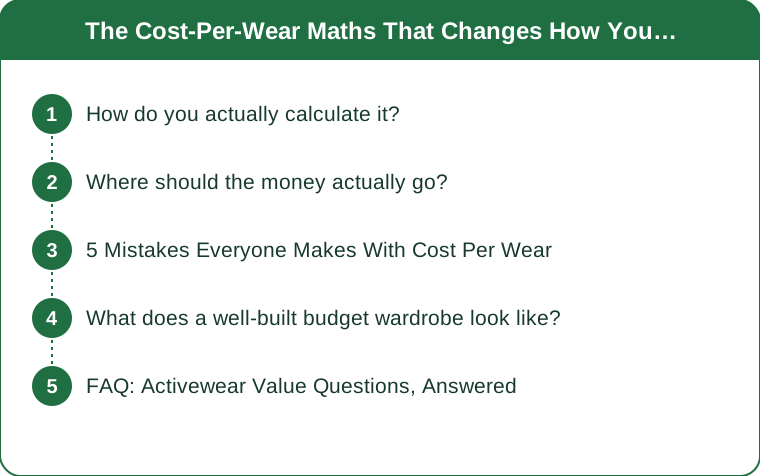
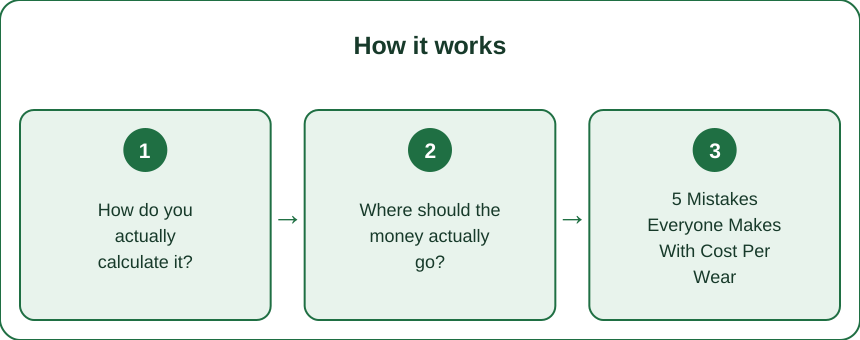
How do you actually calculate it?
The basic formula is straightforward:
Cost per wear = purchase price / total number of wears
The difficulty is estimating total wears honestly, and there are two adjustments most people skip.
Adjustment 1: activewear has a wear-cycle lifespan, not a calendar lifespan. Elastane degrades through washing and stretching, not through time on a shelf. A sports bra rated for roughly 100 to 150 wear-and-wash cycles hits that whether it takes one year or four. So the honest denominator is not how long you will own it - it is how many cycles it has in it.
Adjustment 2: use realistic frequency, not aspirational frequency. The gap between the training schedule you intend and the one you have is where cost-per-wear calculations go wrong.
A worked example. Leggings at £80:
- Worn 3x weekly for 2 years = about 300 wears = 27p per wear
- Worn 2x monthly for 2 years = about 48 wears = £1.67 per wear
Same garment, same price, and a difference of more than six times. Frequency dominates the equation. Price is the smaller variable, which is the opposite of how most people shop.
Where should the money actually go?
Run the maths across categories and a clear pattern emerges.
Worth spending on:
- Sports bras, if you train regularly. High wear frequency, high consequence if it fails, and a genuine performance difference between good and bad. Often the highest cost-per-wear item in a wardrobe and still worth it.
- The leggings you actually wear most. Not all of them - the two pairs in rotation.
- Trainers, because the failure mode is injury and the wear count is high.
Not worth spending on:
- Anything for an activity you have done fewer than ten times. The cost per wear on specialist kit for a hobby you are trialling is enormous.
- Trend colours and seasonal prints, which get worn less because they coordinate with less.
- The fifth pair of leggings. Additional units of something you already have enough of divide your total wears across more garments, raising the cost per wear of every pair.
- Matching sets, unless you would happily wear each half separately. A set that only works together halves your outfit combinations relative to two separates.
The counterintuitive conclusion: owning less, and using each item more, lowers cost per wear across the whole wardrobe. Buying more cheap things is usually the expensive option.

5 Mistakes Everyone Makes With Cost Per Wear
1. Using it only to justify, never to reject. If the calculation always concludes that you should buy the thing, you are not calculating, you are rationalising. It is at least as useful for talking yourself out of purchases.
2. Ignoring the cost of the things it displaces. A new pair of leggings does not add wears - it splits your existing wears across more items. Every pair in the drawer gets used less.
3. Forgetting care costs. Items requiring special washing, hand washing, or frequent replacement of accessories have real ongoing costs that never appear in the calculation.
4. Treating clearance as automatically good value. 60 percent off something you wear four times is worse value than full price on something you wear two hundred times. The mistake that catches out even careful shoppers is buying an end-of-season bargain in a colour or cut they would never have chosen at full price - the discount changed the decision, and the wear count reflects that.
5. Not tracking anything. You do not need a spreadsheet. Noting the month you bought your two most-worn items, and roughly how often you wear them, gives you a real figure to use next time instead of a guess.
What does a well-built budget wardrobe look like?
Optimising for cost per wear across a whole wardrobe tends to produce something small and heavily repeated.
A workable core for someone training three or four times a week:
- 2 sports bras in the support level you need most (rotating them roughly doubles the life of each)
- 2 pairs of leggings in a plain dark colour that goes with everything
- 3 to 4 tops in colours that work with both pairs
- 1 pair of shorts, if you use them
- 1 layer - a light zip-up or long-sleeve
- 1 pair of trainers appropriate to your main activity
That is roughly ten items, and every one of them is worn constantly, which is exactly what drives the cost per wear down.
Then spend where the wear count is highest. If your ten items cost £400 total and get used four times a week for two years, that is around 400 wears each for the leggings and bras. The maths supports spending real money on those and very little on anything else.
And replace on condition, not on boredom. A sports bra whose band has lost tension is finished regardless of how it looks. A pair of leggings that has gone sheer or baggy at the knee is finished. Those are the real signals, and neither has anything to do with what is new in a shop.
FAQ: Activewear Value Questions, Answered
Is expensive activewear actually worth it?
For high-frequency items - the bra and leggings you wear several times a week - usually yes, because the cost per wear becomes trivial and the performance difference is real. For occasional-use items, almost never.
How long should leggings last?
With regular use and correct washing, roughly 12 to 24 months before the elastane loses recovery. Lifespan is driven by wash-and-wear cycles rather than by calendar age.
How many pairs of leggings do I actually need?
Two or three in regular rotation covers most training schedules. Beyond that, each additional pair splits your wears further and raises the cost per wear of everything you own.
TL;DR:
- Cost per wear = price divided by realistic wears, and frequency matters far more than price.
- Activewear ages by wash-and-wear cycles, not by years - so estimate cycles, not calendar time.
- Spend on the bra, the two pairs of leggings, and the trainers; save on everything occasional.
- Owning fewer items and wearing each more lowers cost per wear across the whole wardrobe.
Used honestly, the calculation is less a justification tool than a filter. It tends to conclude that you should buy better and buy less, which is inconvenient advice and usually the right answer.
See It in Motion
Seen here: High Waist Yoga Leggings with Side Pockets — shop it on bubblelime.com
Keep Reading
This article is for general informational and styling purposes only. Fit, sizing, and product availability may vary.