How to Actually Track Cost-Per-Wear on Activewear (Without Overcomplicating It)
Quick Answer: The simplest cost-per-wear tracking method is a basic spreadsheet with just three columns — item, price, and wear count — updated once a week rather than after every wear, which is enough data to reveal which pieces are actually worth their price over a few months.
Cost-per-wear is one of the most useful budgeting concepts for activewear, but most people abandon tracking it because they try to log every single wear in real time, which is more effort than the insight is worth.

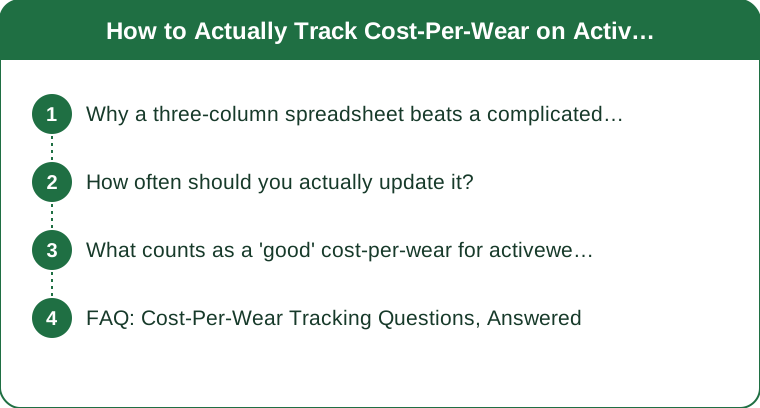
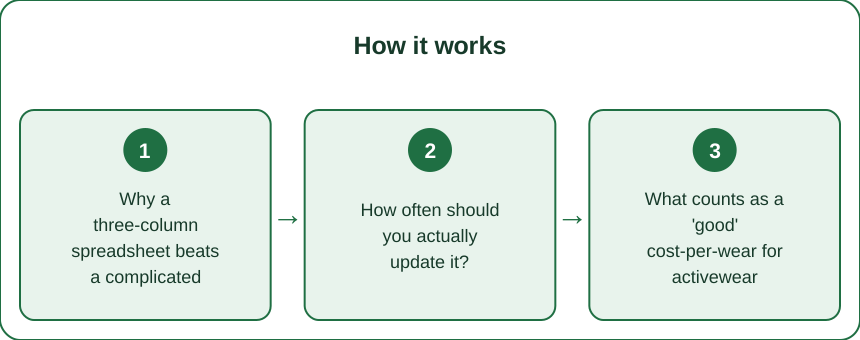
Why a three-column spreadsheet beats a complicated tracking app
A simple spreadsheet with item name, purchase price, and a running wear tally gives you everything needed to calculate cost-per-wear (price divided by wears) without the friction of a dedicated app, which most people stop using within a few weeks because it demands too much real-time logging.
How often should you actually update it?
Updating once a week — a quick mental tally of what got worn — is realistic and sustainable, compared to trying to log immediately after every wear, which is the main reason most tracking attempts get abandoned early.

What counts as a ‘good’ cost-per-wear for activewear specifically?
There’s no universal number, but a common informal benchmark is aiming for cost-per-wear to drop below the price of a single low-cost replacement item (roughly $5-10) within the first year of ownership — pieces that don’t reach that within a year are candidates for reconsidering future similar purchases.
FAQ: Cost-Per-Wear Tracking Questions, Answered
Does cost-per-wear tracking work for expensive and cheap items the same way?
Yes — the calculation is the same regardless of price point; it’s specifically useful for comparing whether an expensive item’s higher upfront cost is justified by more frequent wear.
What should I do with items that have a consistently high cost-per-wear?
That’s useful data for future purchasing decisions — it doesn’t mean getting rid of the item, but it’s a signal to buy differently next time.
Is a spreadsheet really better than a tracking app for this?
For most people, yes — the simplicity reduces the friction that causes most tracking habits to be abandoned, though an app works fine for anyone who’ll actually keep using it consistently.
TL;DR:
- A basic three-column spreadsheet (item, price, wear count) is enough data for meaningful cost-per-wear insight
- Weekly updates are more sustainable than trying to log every single wear in real time
- A rough benchmark: cost-per-wear should drop below $5-10 within the first year for most pieces
- The goal is informing future purchases, not judging past ones
Start a simple three-column spreadsheet this week and just track weekly instead of trying to log every wear — sustainability matters more than precision here.
See It in Motion
Seen here: High Waist Jogger Sweatpants with Pockets — shop it on bubblelime.com
Keep Reading
This article is for general informational and styling purposes only. Fit, sizing, and product availability may vary.